Chinese Chengyu Comparisons: Choose by Meaning, Action and Tone
Revised · Chinese idiom meanings, stories and practice
Start with the difference your sentence needs to express. Are you describing a useful repair, a possible benefit, an addition’s effect or the way someone uses prepared information? Choose a focused comparison, or use the pair directory when you already know the two idioms.
Choose the question before the pair
On a narrow screen, scroll this table sideways to read all columns.
| Your question | Start here | What to check |
|---|---|---|
| Is this idle waiting or a useful correction? | 守株待兔 vs 亡羊补牢 | The actual action, not only a shared theme. |
| Does the sentence describe a beneficial turn or a repair? | 塞翁失马 vs 亡羊补牢 | Outcome and corrective action are separate claims. |
| Was a change corrective or precautionary? | 亡羊补牢 vs 未雨绸缪 | The earlier mistake or the relevant later event. |
| Did an addition weaken or improve the result? | 画蛇添足 vs 锦上添花 | The starting result and consequence of the addition. |
| Is someone following clues or reading mechanically? | 按图索骥 vs 照本宣科 | The method and delivery; some contexts are neutral. |
| Is a benefit known, possible or unrelated? | 塞翁失马 vs 因祸得福 | Preserve overlap and actual outcome status. |
The question gives the comparison a purpose. A checklist after a mistake and before the next event can be described from two time references. An opportunity that follows rejection and an action that fixes an application problem are different facts. Do not select an idiom merely because both entries concern “caution” or “effort.”
Three steps for a new sentence
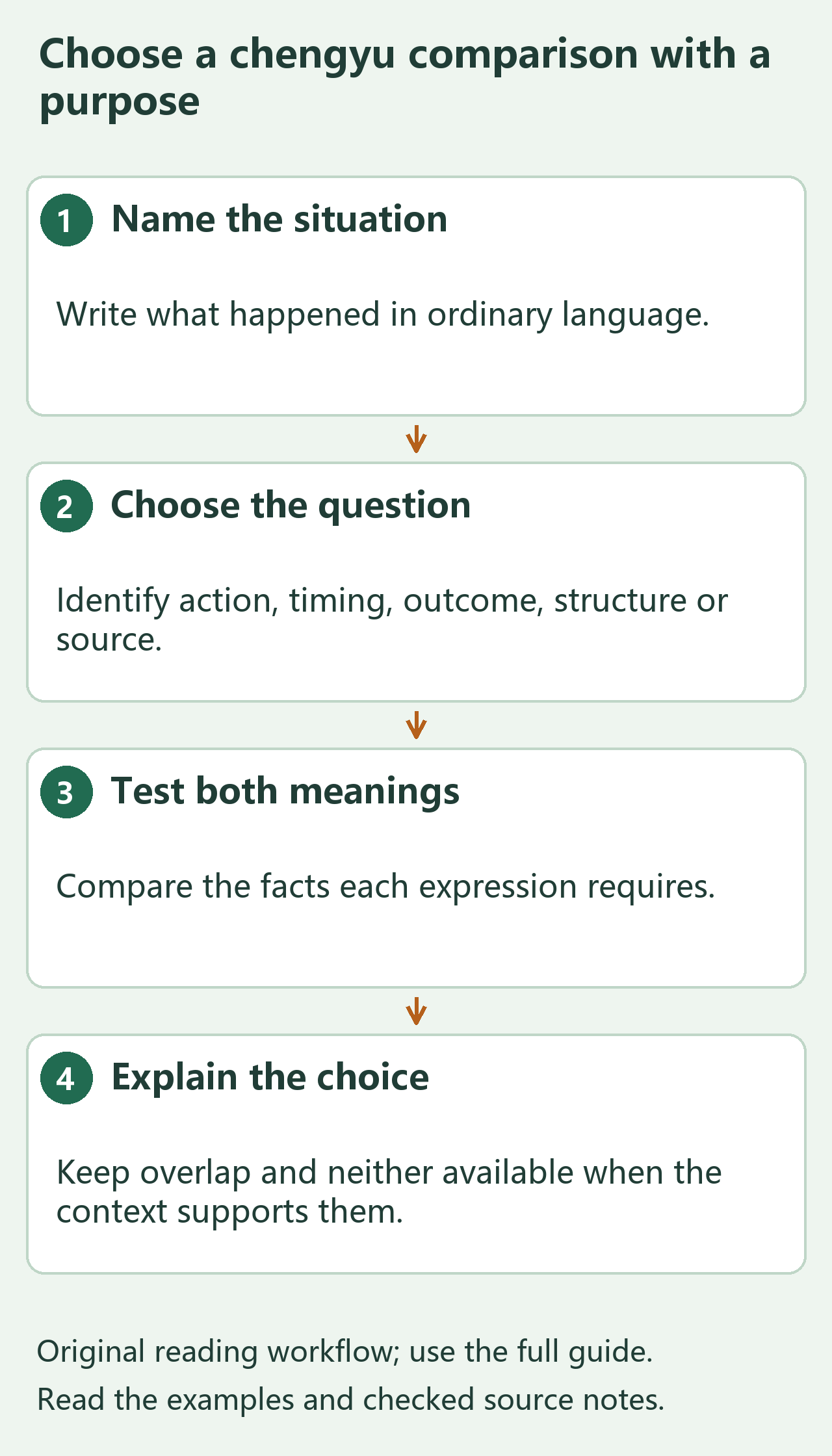
- Write what happened in ordinary words. Include the action, event or result your reader needs to understand.
- Identify the relationship the idiom adds: a correction, a precaution, a harmful addition, a beneficial turn or another specific judgment.
- Try the other expression and explain what it changes. If neither is supported, keep the ordinary wording.
For example, “She waited for the reply due tomorrow after submitting all documents” does not automatically criticize her as 守株待兔. “She introduced a document check after an omission” can support 亡羊补牢. The facts, rather than the shared idea of waiting or a task label, decide the choice.
Sometimes two expressions fit with different emphases. A sentence can describe a known beneficial turn with 塞翁失马 or 因祸得福. That overlap is useful information; a comparison should not invent a rigid distinction simply to force one answer.
When meaning is right but the sentence is not
If your difficulty is particle choice, missing verbs or the expression’s position, use the twelve sentence-repair exercises. They preserve the intended facts while testing structures and meanings. A synonym comparison cannot by itself repair a missing action verb.
For an ongoing study routine, the learning theme helps you explore related vocabulary. Use a single dictionary entry when you need one expression’s pronunciation and definition, then return here for the particular choice that remains unclear.
When the story is the question
If two explanations give different story details, separate a source passage from a modern adaptation. The story-source verification guide shows how to record the consulted entry, version and classical locator. A lively anecdote does not establish an expression’s earliest surviving use.
After checking the source, return to the sentence task. Knowing where a story is recorded does not determine whether a modern example describes an action, an outcome or a respectful response to another person.
All existing pair comparisons, grouped by the first idiom
Open the group for the first expression in the pair. These links retain the existing comparison pages. For a longer explained exercise, use the task-specific worksheets above.
Starting with 守株待兔 (3)
Starting with 画蛇添足 (5)
Starting with 马马虎虎 (13)
Starting with 乱七八糟 (7)
Starting with 刻舟求剑 (7)
Starting with 拔苗助长 (5)
Starting with 勤能补拙 (7)
Starting with 水滴石穿 (3)
Starting with 破釜沉舟 (6)
Starting with 塞翁失马 (4)
Starting with 井底之蛙 (9)
Starting with 南辕北辙 (4)
Starting with 胸有成竹 (3)
Starting with 融会贯通 (5)
Starting with 百折不挠 (7)
Starting with 举一反三 (4)
Starting with 温故知新 (3)
Starting with 青出于蓝 (1)
Starting with 一模一样 (1)
Starting with 以心换心 (1)
Starting with 门庭若市 (4)
Starting with 差强人意 (4)
Starting with 杯弓蛇影 (5)
Starting with 一波三折 (1)
Choose a chengyu comparison with a purpose
Examples to work through
These teaching checks explain a choice about meaning, wording or the story source.
You have two headwords already
Use the directory below to find the pair. First write the concrete difference you need to express; a matching topic or English gloss is not sufficient.
You have a scenario but no headword
Use the question table. A repair after an omission, advance preparation and a later beneficial turn lead to different comparisons.
Two choices both seem possible
Check whether the sentence emphasizes different events or whether the meanings overlap. A comparison can legitimately accept both with explained emphasis.
Neither expression matches the facts
Use ordinary wording. A reasonable wait is not necessarily passivity, and regret is not a repair. Changing the facts just to force an idiom defeats the exercise.
A comparison question record
Use these optional reminders to mark fields you want to keep in your own notes. The downloadable blank sheet contains every record field. Keep your completed record in your own appropriate private place.
Frequently asked questions
Are all comparison pairs synonyms?
No. Some contrast actions, timing, outcomes or evaluation. Use the actual sentence question rather than assuming a single synonym relationship.
Should every exercise have exactly one correct headword?
No. Some contexts allow overlap or different emphases, and some establish neither. The explanation should identify the deciding facts.
What if I need to fix grammar rather than choose meaning?
Use the linked sentence-repair worksheet. It checks verbs, position, particles and semantic compatibility while retaining the intended facts.
Can a story alone prove a modern sentence fits?
No. Check the source for the story claim, then test the modern action, result and tone separately.
Sources and what they support
- MOE Dictionary of Chinese Idioms: 亡羊補牢
The 2020 Advanced entry reproduces Chu Strategies IV, including the proverb spoken by Zhuang Xin to King Xiang. Its definition and examples value timely correction; one example expressly distinguishes remedy from compensation for earlier loss.
- MOE Dictionary of Chinese Idioms: 塞翁失馬
The 2020 Advanced entry reproduces Huainanzi, Ren Jian, and records later complete-idiom attestations. Its examples include both an open outcome and an achieved benefit; the near-synonym is 因禍得福.
- MOE Dictionary of Chinese Idioms: 未雨綢繆
The 2020 Advanced entry supplies the advance-preparation meaning and the Shijing, Bin Feng: Chi Xiao image. The poem also mentions an earlier loss; preparation concerns the relevant later event rather than a life with no previous trouble.
- MOE Dictionary of Chinese Idioms: 畫蛇添足
The 2020 Advanced entry reproduces Zhanguo Ce, Qi Strategies II: Chen Zhen uses the snake contest to persuade Zhao Yang. The ground, wine, addition of feet and loss of the reward are in the reproduced account.
- MDBG / CC-CEDICT: 守株待兔
The dictionary row gives shǒu zhū dài tù and idle waiting for opportunities or trusting chance rather than initiative. Only the dictionary row supports this comparison; optional AI descriptions and an exhaustive classical-origin history are not used.
Source entries checked on 4 November 2026 UTC. Modern examples, English renderings, reading schematics and blank records are original learning aids. The consulted dictionary reproductions do not establish a complete classical-book reading, an all-editions comparison or an exhaustive earliest-use study.