Practical guide
How to Verify the Source of a Chinese Idiom Story
Separate a story source, a complete idiom attestation and a modern retelling. Two checked dictionary entries, short Chinese excerpts with original English renderings, a citation table, a downloadable record and six explained cases show how to keep the evidence traceable.
Decide which source claim you want to verify
To verify a Chinese idiom story, separate three questions: where the underlying story or image is recorded, where the complete idiom wording is documented, and who wrote the modern retelling you are reading. The answers can point to different texts. A book title beneath a story is a starting clue, not proof of every detail in that story.
This guide uses two fully checked entries from the Ministry of Education’s Dictionary of Chinese Idioms: 畫蛇添足, “draw a snake and add feet,” and 按圖索驥, “seek a fine horse by following a picture.” The examples show how to read the evidence, retain its limits and write a traceable citation. They are selected examples, not a survey establishing the earliest surviving use of every idiom.
Define a small claim before searching. “Does the reproduced passage describe a snake-drawing contest?” can be checked against its words. “Who first invented this expression?” requires a much broader investigation. Do not turn an answer to the first question into a confident answer to the second.
A source text also records a narrative; finding it does not independently prove that every reported event happened exactly as told. For a learner’s source note, say that the text records or relates the story. Keep a historical fact claim separate if you have not investigated it.
Read the dictionary sections as different kinds of evidence
Open the full entry and identify its headword, pronunciation, definition, source passage, source explanation, documented uses and related forms. These sections do different jobs. The headword tells you the expression under discussion; it does not guarantee that the complete modern form appears in every quoted older passage.
Pay attention to the dictionary’s linking words. The 畫蛇添足 entry says 典出, connecting its allusion to 《戰國策.齊策二》. The 按圖索驥 entry says 語本, based on wording in the Mei Fu material of 《漢書》, volume 67. Read those statements with the reproduced words rather than flattening them into “the author coined these exact four characters.”
A source explanation is a modern account of the passage and its development. It can help with difficult language, but it is not the same thing as the classical quotation. Later documented examples establish particular uses of an expression. Related-word material may record a different form or an anecdote used to illustrate the idea.
The two entries consulted here display the online dictionary’s 2020 [Advanced] version. That identifies the resource used for this guide. We did not compare printed critical editions, read every passage in either classical book or establish an exhaustive earliest-use chronology. State the version and scope that you actually checked.
Compare the reproduced Chinese with a labelled English rendering
The first three lines below are short excerpts from the snake story reproduced in the MOE 畫蛇添足 entry. The fourth comes from the horse-image comparison reproduced in its 按圖索驥 entry. Chinese note-reference markers are omitted; the substantive quoted words are retained. The English is our original plain-language rendering, not a quotation from a published English translation.
| Source point | Chinese excerpt | Original English rendering | What it establishes |
|---|---|---|---|
| Snake contest | 請畫地為蛇,先成者飲酒。 | Let us draw snakes on the ground; whoever finishes first drinks the wine. | The contest and reward are in the reproduced source. |
| Objection to the feet | 蛇固無足,子安能為之足。 | A snake has no feet; how can you give it feet? | The objection concerns adding an unsuitable feature. |
| Consequence | 為蛇足者,終亡其酒。 | The person who added feet to the snake ultimately lost his wine. | The unnecessary addition costs the first finisher his reward. |
| Horse-image comparison | 猶察伯樂之圖,求騏驥於市 | Like examining Bole’s drawings while seeking fine horses in the market. | This is an underlying image, not the full wording 按圖索驥. |
In the snake passage, several retainers have wine sufficient for one person but insufficient for the group. They agree to the drawing contest. The first finisher begins adding feet, another completes a snake and takes the wine, and the person adding feet loses it. A modern retelling can summarize that sequence without pretending its own sentences are the ancient text.
The dictionary’s longer reproduced passage places the anecdote within Chen Zhen’s persuasion of Zhao Yang. The warning concerns continuing after success in a way that risks what has already been gained. Omitting that frame can be reasonable in a short classroom retelling, but it is an omission, not evidence that the source contains only an isolated drawing lesson.
For modern usage, the harmful-addition and welcome-improvement comparison handles sentence choice separately. Knowing the story’s location does not automatically decide whether an idiom fits a new sentence.
Check whether a familiar anecdote belongs to a variant
按圖索驥 provides a useful warning about origin shortcuts. The main MOE source connection points to Han Shu, volume 67, in the Mei Fu material. Its reproduced image concerns using Bole’s drawings to seek fine horses in the market, within an argument about applying an old model of selecting people. The complete four-character headword is not present in the short line quoted above.
The same entry separately records 按圖索駿, a related form whose final character is 駿 rather than 驥. Under that form, it includes the familiar anecdote about Bole’s son consulting the horse manual and mistaking a large toad for a horse. The named work is Yang Shen’s 《藝林伐山》, volume 7, “相馬經.” Do not move that anecdote into the main Han Shu quotation or erase the variant when reporting what the dictionary shows.
A careful note can say: “The entry connects 按圖索驥 with an older horse-image comparison and separately records a later explanatory anecdote under 按圖索駿.” That is more precise than saying the toad story is certainly the sole earliest origin. The dictionary’s selected records do not, on their own, settle the first surviving occurrence of either complete form.
The method, clue-following and mechanical-reading guide explains current usage. A lively story should not force every modern occurrence of 按图索骥 into a negative translation; the entry also records a clue-following sense.
Keep the consulted version and quotation changes visible
Record the source you actually opened: entry title, dictionary version, book and chapter or section locator, URL and access date. If you used a dictionary reproduction, cite that reproduction. A reference to a whole classical work does not identify which edition you read or where another reader should look.
Retain the Chinese form shown in a quotation. You may provide a simplified form beside a traditional headword for learners, but label a converted quotation if you change its characters. Do not silently treat a related form such as 按圖索駿 as though it were an exact match for 按圖索驥.
If you omit part of a passage, use a clear omission convention and preserve the meaning across the gap. A short excerpt needs enough surrounding explanation to identify the speaker, action or comparison. Avoid joining two nonadjacent fragments so that they appear to be one continuous sentence.
Distinguish substantive changes from presentational handling. In this guide’s short Chinese excerpts, numeric links to dictionary notes are omitted. We retain the source’s words rather than inserting the modern idiom into an older line. Our English rendering is identified as original, so the reader can separate source text from translation.
If two editions genuinely differ, record each version and the specific difference before offering an explanation. If you have checked only one reproduction, say that. A possible variant is a question to investigate, not permission to invent a manuscript comparison.
Audit a modern retelling for added or missing details
Compare a retelling with the source in three passes. First check the central sequence: starting situation, action and consequence. Then check concrete details such as the participants, reward and setting. Finally identify the explanatory lesson and who supplied it. A memorable moral may be an editor’s interpretation rather than a sentence quoted from the original.
For the snake story, “draw on the ground” is supported by 畫地為蛇. Replacing the ground with a classroom sheet of paper can create a useful adaptation, but it changes the scene. Label it as an adaptation rather than reporting the new setting as a source detail. Similarly, shortening several participants to two finalists should remain visible as simplification.
An original retelling can be brief and readable: “The first person finishes a snake, but adds feet instead of stopping. Another finishes and takes the wine. The unnecessary addition costs the first person the reward.” Those are our sentences summarizing the reproduced account, not translated quotations to attribute word for word to its author.
Do not add an invented date, named student, teacher’s reaction or speech to make the story feel complete. If you create dialogue for a classroom activity, call it invented dialogue. An accessible story and an accurate source note can coexist when the boundary is explicit.
The single-idiom story page has a narrower retelling task. Use this source-checking method to ask which of its details are supported, and use the full idiom entry for meaning and original usage examples.
Write a citation another reader can actually follow
Use a short evidence record before writing an origin note. The example below records what was consulted here, while leaving room for your own actual access date. It separates the classical locator from the online reproduction and the wording contributed by the modern writer.
| Field | Example | Limit or action |
|---|---|---|
| Headword | 畫蛇添足 / 画蛇添足 | Record the form you searched and any variant. |
| Text locator | 《戰國策.齊策二》 | Copy the book and section supplied by the source. |
| Version consulted | MOE Dictionary of Chinese Idioms 2020 [Advanced], entry ID 23 | This identifies the online reproduction, not a separately checked printed critical edition. |
| Evidence type | Reproduced source passage, source explanation and later examples | Do not merge those sections into one earliest-use claim. |
| Quotation status | Short Chinese excerpt; dictionary note markers omitted | Keep substantive words and disclose changes relevant to the quotation. |
| Your contribution | Original English rendering and modern retelling | Do not attribute your English wording to the classical author. |
| Access and link | Record the date you actually consulted it and the full entry URL | A home page alone does not let another reader find the passage. |
A usable wording is: “The MOE Dictionary of Chinese Idioms, 2020 [Advanced], entry 畫蛇添足, reproduces the story from 《戰國策.齊策二》. The short Chinese excerpt is taken from that reproduction; the English rendering and summary are my own.” Add the full entry link and your actual consultation date. This is a practical citation model, not a claim that we consulted a separately named printed edition.
Download the source-check record with six explained cases. It has fields for the exact claim, consulted version, evidence type, quotation changes and remaining uncertainties. Do not fill an unknown author, date or edition with a guess merely because the field is blank.
View the source-check route. The original diagram keeps the claim, passage, relationship and citation together. A complete record is useful because another reader can repeat the check; it is not a stamp certifying that every possible origin question has been settled.
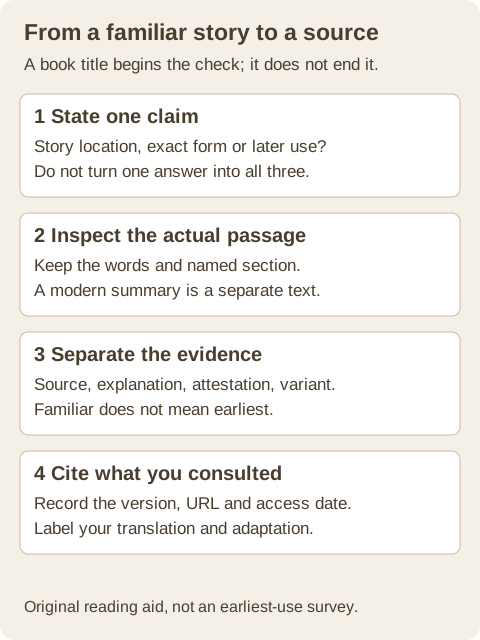
Six checks before publishing an idiom origin note
These original fictional cases test what a source supports and how to label your contribution. Open the explanations after choosing a reasonable conclusion. They are source-reading exercises, not reports of an exhaustive textual study.
Case 1
A dictionary says a four-character idiom is based on an older passage, but those four characters do not appear together in the reproduced line. Can you claim the complete idiom occurs verbatim there?
Show answer and explanation for case 1
No. Identify it as the underlying passage or image, not an exact occurrence of the complete form.
The MOE 按圖索驥 entry marks the connection as 語本 and reproduces a horse-image comparison in the Mei Fu material of Han Shu volume 67. Check the actual words rather than transferring the modern headword into the quotation.
Case 2
A famous frog-for-a-horse anecdote appears under a related variant in a later work. Is its familiarity enough to make it the sole earliest source of 按图索骥?
Show answer and explanation for case 2
No. Preserve the variant, named work and relationship to the main entry.
The MOE entry lists the anecdote under 按圖索駿 in Yang Shen’s Yi Lin Fa Shan, volume 7, “Xiang Ma Jing.” That is separate from its main Han Shu origin connection. This selected evidence does not establish the earliest surviving use of either form.
Case 3
You translate 蛇固無足 into your own English sentence. May you put the English in quotation marks and attribute its exact wording to the classical author without explaining the translation?
Show answer and explanation for case 3
No. Label the English rendering as your translation or paraphrase.
The classical Chinese words and your English wording are different records. Give the source locator and identify your contribution. Quotation marks alone do not identify who produced a translation.
Case 4
For a classroom adaptation, you change drawing on the ground into drawing on paper. Can you present the adapted scene as a direct quotation of the reproduced source?
Show answer and explanation for case 4
No. It is an adaptation and should be labelled as one.
The source comparison here includes 畫地為蛇, drawing a snake on the ground. You may simplify or adapt a story for a stated teaching purpose, but do not silently replace a source detail inside a quotation or report the new detail as source evidence.
Case 5
A later novel contains 畫蛇添足 in a sentence. Does that documented example alone prove the novelist invented the idiom?
Show answer and explanation for case 5
No. An attestation shows use in that recorded passage, not authorship of the expression.
The MOE entry separates the source story from later documented uses, including a passage in Romance of the Three Kingdoms. A selected example is not an exhaustive search for the first surviving occurrence.
Case 6
You have read only the dictionary’s reproduced excerpt and source note. Should the citation say you checked the entire classical book in a named printed edition?
Show answer and explanation for case 6
No. Cite the reproduction you actually consulted and retain the limit.
A precise online entry, book and section locator let another reader check the evidence. They do not establish a full-book reading, comparison of printed editions or manuscript research that you did not perform.
Sources and further reading
- MOE Dictionary of Chinese Idioms 2020 [Advanced]: 畫蛇添足, entry 23Complete visible entry: Zhanguo Ce, Qi Strategies II source excerpt, Chen Zhen and Zhao Yang framing, source explanation, later documented uses and related forms. Short quotations reproduce its Chinese words with note markers omitted; the English renderings and worksheet are original.
- MOE Dictionary of Chinese Idioms 2020 [Advanced]: 按圖索驥, entry 158Complete visible entry: 語本 connection to Han Shu volume 67, Mei Fu material; reproduced horse-image comparison; later attestations; and the separately listed 按圖索駿 anecdote from Yang Shen’s Yi Lin Fa Shan. No exhaustive earliest-use or complete critical-edition study is claimed.
Read the original claim and ending
These two learner guides use located classical passages and original sentence checks:
Plans, practical limits and repeated reports
Read each meaning with its consulted source, original examples and a context exercise.
Imagination, useful substance and what a choice keeps
Three different headwords, each with its consulted source, original Chinese sentences and a context exercise.
Help, affection, effort and returning: eight distinct headword guides
Choose the expression whose meaning, source and sentence context answer your question.
- 雪中送炭 (xuě zhōng sòng tàn): Timely Help, Meaning and Examples
- 爱屋及乌 (ài wū jí wū): Affection by Association and Usage
- 乘风破浪 (chéng fēng pò làng): Ambition, Sailing and Examples
- 安步当车: Meaning, Dictionary Pronunciations and Calm Walking
- 卧薪尝胆 (wò xīn cháng dǎn): Resolve, Source and Examples
- 乐不思蜀 (lè bù sī shǔ): Forgetting to Leave, Story and Tone
- 完璧归赵 (wán bì guī zhào): Returning an Item and Its Jade Story
- 打草惊蛇 (dǎ cǎo jīng shé): Alerting Someone, Origin and Usage
Reality checks, indirect relief and seeing the whole issue
Use each guide’s actual source scope, original examples and question-specific comparisons.
Reading, clear presentation and actual results
Distinguish what is quick, what is clear, and which outcomes have actually been supplied.
Choose the sense, subject and context
Compare decisiveness with a break, focus with united purpose, and money possessed with a judgment about value. Each guide includes original Chinese sentences and a context exercise.
- 一刀两断 (yī dāo liǎng duàn): Three Meanings, Variant and Examples
- 一五一十 (yī wǔ yī shí): Counting, Detailed Accounts and Examples
- 一心一意 (yī xīn yī yì): Focus, Intention and Chinese Examples
- 一心一德 (yī xīn yī dé): United Purpose, Variant and Examples
- 一文不名 (yī wén bù míng): Poverty, Meaning and Chinese Examples
- 一孔之见 (yī kǒng zhī jiàn): Limited View, Context and Examples
- 一毛不拔 (yī máo bù bá): Stinginess, Source Wording and Examples
- 一文不值 (yī wén bù zhí): Value, Variants and Chinese Examples
Match the image, task and cited wording
These guides distinguish longing from calendar time, character from value, task responsibility from power manipulation, and a shared principle from identical methods. Check the cited wording, original examples and context exercises.
- 一日三秋 (yī rì sān qiū): Longing, Expanded Form and Examples
- 一介不取 (yī jiè bù qǔ): Integrity, Proper Entitlement and Examples
- 一手包办 (yī shǒu bāo bàn): Whole-Task Ownership, Variants and Examples
- 一片冰心 (yī piàn bīng xīn): Poem Wording, Meaning and Examples
- 一反常态 (yī fǎn cháng tài): Usual Pattern, Change and Examples
- 一元复始 (yī yuán fù shǐ): New Year, Source Wording and Examples
- 一手遮天 (yī shǒu zhē tiān): Power, Deception and Chinese Examples
- 一木难支 (yī mù nán zhī): Needed Support, Variants and Examples
- 一丘之貉 (yī qiū zhī hé): 貉 Reading, Negative Tone and Examples
- 一以贯之 (yī yǐ guàn zhī): One Principle, Different Methods and Examples
- 一了百了 (yī liǎo bǎi liǎo): Related Problems, 了 Reading and Examples
- 一之谓甚 (yī zhī wèi shèn): Meaning, Variant Reading and Examples
Time, departure and connected advantages
Compare exact quoted lines, recorded readings and the relation a sentence actually describes.