Practice worksheet
Wang Yang Bu Lao vs Wei Yu Chou Mou: Timing and Usage
亡羊补牢 (wáng yáng bǔ láo) emphasizes timely correction after a mistake or loss. 未雨绸缪 (wèi yǔ chóu móu) emphasizes preparation before a relevant later difficulty. Identify the event your sentence focuses on: the same checklist can correct last time’s weakness and prepare for next time’s risk.
Choose by the event, action and purpose
| Situation | Closer expression | Reason |
|---|---|---|
| A loss exposes a weakness; someone corrects it. | 亡羊补牢 | The sentence looks back at a setback and values timely correction. |
| A possible future difficulty prompts preparations. | 未雨绸缪 | The sentence looks ahead and emphasizes readiness. |
| Someone regrets a mistake but takes no corrective action. | Neither follows from that fact alone. | Regret is not the repair in 亡羊补牢. |
| Someone completes an ordinary task with no stated risk. | More context needed. | Doing something early is not automatically precautionary preparation. |
| An improvement follows one failure and precedes another event. | Either may fit a different emphasis. | Identify whether the sentence centers the earlier loss or the later risk. |
For 亡羊补牢, look for a mistake or loss and a correction that still matters. For 未雨绸缪, look for a possible later difficulty and preparations made before it. The Ministry of Education’s idiom dictionary describes these as timely remedy and advance precautions respectively.
These expressions are often contrasted in study materials, but “after” and “before” need a reference point. A person may have learned from a previous failure while preparing for a future event. Choose the focus your sentence communicates rather than assuming that one past mistake permanently rules out 未雨绸缪.
Characters, pinyin and the literal images
| Simplified | Traditional | Pinyin | Image |
|---|---|---|---|
| 亡羊补牢 | 亡羊補牢 | wáng yáng bǔ láo | Mend the pen after sheep are lost. |
| 未雨绸缪 | 未雨綢繆 | wèi yǔ chóu móu | Strengthen the shelter before rain. |
亡羊补牢 has second, second, third and second tones. 亡 means lost here; do not require the sheep to have died. 牢 is the animal enclosure in this image, not a prison in the modern story you are describing. The metaphor carries the relationship between a loss and a repair.
未雨绸缪 has fourth, third, second and second tones. 未 means not yet; the expression places preparation before the relevant rain or figurative difficulty. Read the last two syllables chóu móu. The MOE entry explains 綢繆 as binding or strengthening and warns against substituting 謬. The simplified headword is 未雨绸缪, not 未雨绸谬.
Pinyin here records the dictionary forms. In a connected sentence, pronunciation can be affected by neighboring syllables; that does not change the headword. Neither expression requires a literal animal pen or a rainy day in modern use.
Follow the two timelines—and test an overlap
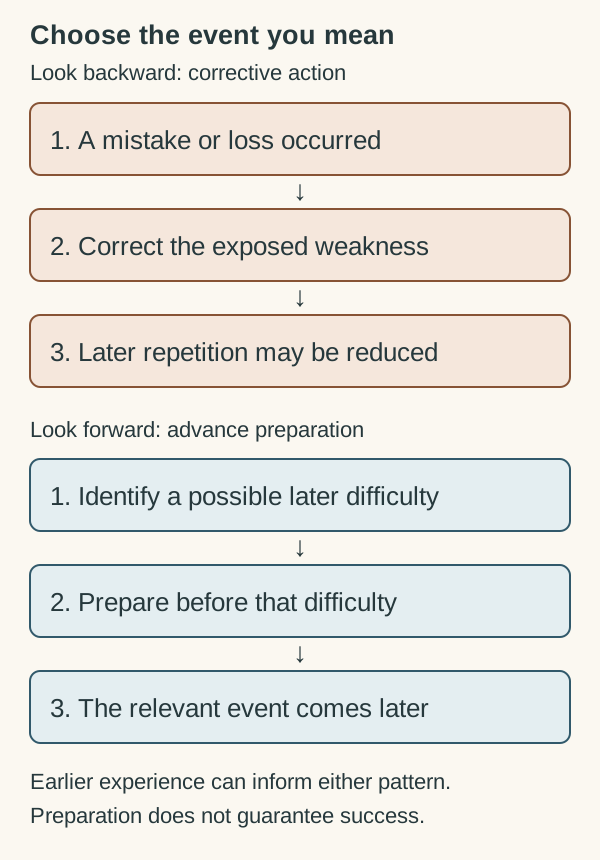
Read the first pattern as earlier setback → corrective action → possible reduction in later repetition. That fits 亡羊补牢 when the sentence emphasizes the correction after something went wrong. Read the second as anticipated difficulty → preparation → later event. That fits 未雨绸缪 when the sentence emphasizes readiness before the relevant difficulty.
One checklist, two defensible descriptions
Imagine an event had a wrong attendance list. The organizer introduces a checking stage for the next event. Looking back, the new stage addresses the earlier mistake: 亡羊补牢. Looking ahead, it prepares against another list error: 未雨绸缪. The actions have not changed; the emphasized event has.
Make that reference visible with “after last time’s error” or “before the next event.” If a test question supplies only the word “checklist,” it does not establish either interpretation. The time, purpose and actual correction or precaution are what make the choice meaningful.
What the source notes establish about the images
The MOE 亡羊補牢 entry identifies Zhanguo Ce, “Chu Strategies IV” (《战国策·楚策四》), and recounts Zhuang Xin’s advice to King Xiang of Chu after political losses. The sheep-pen proverb illustrates why remedial action can still be worthwhile. This source context is more specific than calling the origin simply a story about a farmer.
A classroom version about an owner, a broken pen and a neighbor can help memory. Keep it labeled as a retelling rather than presenting each of its details as the wording of the classical passage. This guide has checked the dictionary’s source account; it does not claim to have compared all editions of the classical text.
For 未雨綢繆, MOE marks the origin connection as 語本—based on wording in the Shijing, “Bin Feng: Chi Xiao” (《诗经·豳风·鸱鸮》). Its reproduced passage includes “迨天之未陰雨”, preparing before the sky becomes rainy. In the poem’s bird-and-nest image, 綢繆 concerns binding and strengthening the shelter. The complete modern four-character idiom should not be described as a verbatim line in that excerpt.
The poem also mentions an earlier loss of young birds. That is a useful reminder: preparation before the coming rain does not require a life without any previous trouble. The dictionary records later complete-expression attestations, including a context of learning from the past while preparing ahead. No precise first-use date or named inventor is asserted here.
Eight Chinese examples with pinyin and English
These eight sentences and their English explanations are original teaching examples. They are not quotations or reports of actual events. Pinyin gives a reading aid; the English prioritizes meaning over a forced word-for-word translation.
Correcting a submission process
上次漏交附件后,我们增加了提交前的核对步骤,算是亡羊补牢。
Shàng cì lòujiāo fùjiàn hòu, wǒmen zēngjiā le tíjiāo qián de héduì bùzhòu, suàn shì wáng yáng bǔ láo.
English: After omitting an attachment last time, we added a check before submission—a corrective step after the mistake.
The earlier omission and the new checking step make the repair explicit.
Encouraging a useful late correction
这次没考好,现在改进复习方法,亡羊补牢还来得及。
Zhè cì méi kǎo hǎo, xiànzài gǎijìn fùxí fāngfǎ, wáng yáng bǔ láo hái lái de jí.
English: This exam went poorly, but there is still time to improve the study method.
The sentence encourages action after a setback; it does not claim that the old exam result changes.
Making the correction concrete
发现账目有误后,他们检查了记录流程,采取亡羊补牢的措施。
Fāxiàn zhàngmù yǒu wù hòu, tāmen jiǎnchá le jìlù liúchéng, cǎiqǔ wáng yáng bǔ láo de cuòshī.
English: After finding an error in the accounts, they reviewed the recording process and took corrective measures.
The example names a process correction rather than treating regret as sufficient.
Preparing for possible rain
雨季还没到,学校先检查屋顶,这是未雨绸缪。
Yǔjì hái méi dào, xuéxiào xiān jiǎnchá wūdǐng, zhè shì wèi yǔ chóu móu.
English: Before the rainy season arrives, the school checks the roof as a precaution.
The upcoming rainy season is the relevant event. This is a language example, not a roof-inspection instruction.
Preparing for a presentation problem
会议前,她准备了演示文件的副本,以备设备出问题,可说是未雨绸缪。
Huìyì qián, tā zhǔnbèi le yǎnshì wénjiàn de fùběn, yǐ bèi shèbèi chū wèntí, kě shuō shì wèi yǔ chóu móu.
English: Before the meeting, she prepared a copy of the presentation in case equipment failed.
The copy serves a stated contingency; simply arriving early would not supply the same meaning.
Describing an advance plan
为了应对可能的材料短缺,团队未雨绸缪,提前讨论了替代方案。
Wèile yìngduì kěnéng de cáiliào duǎnquē, tuánduì wèi yǔ chóu móu, tíqián tǎolùn le tìdài fāng’àn.
English: To prepare for a possible material shortage, the team discussed alternative plans in advance.
可能 marks the anticipated difficulty. The wording describes preparation, not a guaranteed outcome.
One action, looking backward
上次活动因名单错误出了问题,这次增加核对环节,是亡羊补牢。
Shàng cì huódòng yīn míngdān cuòwù chū le wèntí, zhè cì zēngjiā héduì huánjié, shì wáng yáng bǔ láo.
English: After list errors caused problems at the last event, adding a checking stage this time is corrective action.
The emphasis is the earlier failure that exposed a weakness.
The same action, looking forward
下次活动还没开始,为防名单再次出错,提前核对也是未雨绸缪。
Xià cì huódòng hái méi kāishǐ, wèi fáng míngdān zàicì chū cuò, tíqián héduì yě shì wèi yǔ chóu móu.
English: Before the next event starts, checking the list in advance also prepares against another error.
The earlier error is compatible with advance preparation for a later event. The time reference has changed.
Keep the tone—and avoid a misleading English shortcut
亡羊补牢 can encourage someone to take a useful corrective step while acknowledging that a mistake has already happened. It can also evaluate an organization’s delayed response. Describe the earlier problem and the corrective action before applying the idiom to another person’s work; the label alone can sound accusatory or vague.
The MOE usage notes explicitly distinguish remedy from compensation for earlier loss: the purpose is to reduce or prevent similar later situations. Do not turn “a useful late correction” into a promise that money, marks or lost opportunities will be restored. A sentence also need not pretend that the correction makes every future failure impossible.
MDBG’s CC-CEDICT row lists “better late than never” alongside “lock the stable door after the horse has bolted.” Those English expressions can imply different attitudes. In an encouraging Chinese context, an English sentence declaring the action pointless would lose the value of timely correction. “They fixed the weakness after the loss” is often the clearest explanatory translation; choose “better late than never” when its encouraging tone fits.
For 未雨绸缪, “prepare in advance,” “plan for a possible difficulty” or “prepare for a rainy day” can preserve the forward-looking purpose. An ordinary early start is not sufficient evidence: name the contingency or later need. The expression is not restricted to literal weather and does not prove that the plan is wise or guaranteed to work.
Sentence patterns such as 亡羊补牢还来得及, “there is still time for a useful correction,” and 未雨绸缪之计, “a plan made in advance,” can help, but they still need context. A stock phrase does not tell the reader what was corrected or what was anticipated.
Ten timing choices with explained answers
Choose 亡羊补牢, 未雨绸缪 or neither / more context needed. If both can describe different perspectives, name the earlier and later events. These original exercises test meaning and timing, not personal character or professional planning.
Case 1
A lost file reveals a weak saving process. The team changes that process after the loss. Which phrase emphasizes the correction?
Show answer and explanation for case 1
亡羊补牢.
The earlier loss and later corrective action are both present. The sentence values fixing the weakness rather than reversing the past.
Case 2
Before a planned event, a team prepares a backup in case a possible equipment failure occurs. Which expression emphasizes readiness?
Show answer and explanation for case 2
未雨绸缪.
The relevant difficulty is anticipated. The preparation precedes it and has a stated precautionary purpose.
Case 3
A person feels bad about a mistake but changes nothing. Does that alone establish 亡羊补牢?
Show answer and explanation for case 3
No; the repair is missing.
Regret may accompany a correction, but the facts given contain no corrective action. Describe regret directly.
Case 4
Someone finishes reading a novel early. No possible difficulty or precaution is mentioned. Must this be 未雨绸缪?
Show answer and explanation for case 4
No; more context is needed.
Early completion alone does not establish advance preparation against a risk or later need.
Case 5
A checklist is introduced after one failed event and before the next. Must one idiom be wrong in every description?
Show answer and explanation for case 5
No. The sentence can focus on different events.
亡羊补牢 can emphasize correcting the earlier weakness; 未雨绸缪 can emphasize preparing for the next event. Name the time reference.
Case 6
A report says 亡羊补牢 proves the earlier financial loss will be recovered. Is that part of the idiom’s meaning?
Show answer and explanation for case 6
No.
Timely correction may reduce later repetition. The expression does not guarantee compensation for an earlier loss or success of a repair.
Case 7
Translate a gently encouraging 亡羊补牢 sentence as “It is pointless now; the horse has already bolted.” Is the attitude preserved?
Show answer and explanation for case 7
No.
That English wording dismisses further action, whereas this Chinese context values a useful late correction. Use a fuller explanation or “better late than never” if it fits.
Case 8
Can 未雨绸缪 describe preparation for an examination or a possible supply problem rather than literal rain?
Show answer and explanation for case 8
Yes.
Rain belongs to the literal image. Figurative use concerns preparation in advance for a relevant later difficulty or need.
Case 9
A learner reads the final character of 未雨绸缪 as miù and writes 未雨绸谬. What should be corrected?
Show answer and explanation for case 9
Use wèi yǔ chóu móu and the correct headword 未雨绸缪.
MOE specifically distinguishes 繆 in 綢繆 from 謬. Pronunciation and character choice must follow this idiom, not another word.
Case 10
Make “They should 亡羊补牢” clearer without inventing a guarantee. What information should you add?
Show answer and explanation for case 10
Name the earlier mistake and the specific corrective action.
For example, an omitted attachment followed by a submission checklist. Keep the focus on the correction rather than promising that all future errors disappear.
Download the practice sheet and rewrite one situation
Download the editable timing-practice sheet and answer notes. It includes all ten cases plus a record for the earlier mistake, corrective action, later risk and advance preparation. The diagram and sheet are original learning aids.
Earlier mistake or loss: __________________________
Specific corrective action: _______________________
Possible later difficulty: ________________________
Advance preparation: ______________________________
The event my sentence emphasizes: _________________
Chosen wording and reason: ________________________
Write two sentences about one checklist. In the first, show how it addresses last time’s omission. In the second, show how it prepares for the next event. Translate each into plain English, then check whether the Chinese expression adds the timing and purpose you intend.
For a different comparison, the addition-and-outcome guide asks whether an extra step helps or harms. The clue-following and mechanical-reading guide asks about method and delivery. A late correction, useful addition and flexible method are distinct features; identify the one your sentence needs to communicate.
Sources and further reading
- MOE Dictionary of Chinese Idioms: 亡羊補牢Mandarin form, timely-remedy meaning, Chu Strategies IV source account and the distinction between correction and compensation for past losses.
- MOE Dictionary of Chinese Idioms: 未雨綢繆Mandarin form, advance-preparation meaning, reproduced Shijing passage, later attestations and the 綢繆/謬 character warning.
- MDBG / CC-CEDICT: 亡羊補牢Independent bilingual headword and pinyin check; English glosses require attention to sentence tone. No optional AI description is used.
- MDBG / CC-CEDICT: 未雨綢繆Independent pinyin and plan-ahead / rainy-day figurative meaning, distinct from the dictionary’s detailed source explanation.