Practice worksheet
Chinese Idiom Sentence Practice: 12 Collocation and Word-Order Exercises
Try twelve original sentence repairs for six Chinese idioms. Check the action, sentence position, particle and meaning, then compare a corrected Chinese sentence, pinyin, English and the reason for the change.
Keep the intention before repairing the sentence
A remembered English gloss does not tell you how a Chinese idiom fits into a sentence. Start with the ordinary action: someone reads a story, recognizes a teacher, gains two benefits or makes the same choice as another person. Then decide what the idiom contributes. Does it describe the action, evaluate the arrangement or name a realization?
The twelve original exercises below include a learner draft, a suggested repair, pinyin, English and a reason. Some drafts have a clear structural error. Others can be read grammatically but describe the wrong referent or contradict the scenario. Treat those as different problems. A useful correction preserves the intended facts instead of inventing a new story that makes the idiom fit.
Try each question before opening the answer. Write one repair and underline the part you changed. If you propose another sentence, compare it with the reason rather than trying to reproduce every word of the model. Several questions deliberately accept more than one natural structure. These are practice materials, not a graded proficiency test or a report of real classroom errors.
Check the six headwords and their dictionary meanings
| Simplified / traditional | Dictionary pinyin | Meaning in these exercises |
|---|---|---|
| 津津有味 / 津津有味 | jīn jīn yǒu wèi | Interest or enjoyment; MOE also records appetite and food-related uses. |
| 一举两得 / 一舉兩得 | yī jǔ liǎng dé | Two benefits from one action. |
| 事半功倍 / 事半功倍 | shì bàn gōng bèi | Less effort with greater effect; efficient results. |
| 举一反三 / 舉一反三 | jǔ yī fǎn sān | Extend understanding from one case to similar ones. |
| 恍然大悟 / 恍然大悟 | huǎng rán dà wù | Suddenly realize or understand. |
| 不约而同 / 不約而同 | bù yuē ér tóng | Matching opinions or actions without prior agreement. |
The definitions and pronunciation checks come from six complete visible advanced entries in the Ministry of Education’s Dictionary of Chinese Idioms. The modern drafts, repairs and translations on this page are original teaching examples. The linked dictionary pages include their own usage examples and source notes; this guide does not present its invented sentences as dictionary quotations.
Keep dictionary pinyin separate from a recording of connected speech. In 一举两得, MOE explicitly gives both the base yī form and the changed yì reading before jǔ. The written aids here use the base form consistently, including yī inside sentences. Neighboring tones can affect actual speech. Pinyin also cannot distinguish 的、地 and 得 when each is read de in these structures.
Choose a sentence job before choosing a particle
An idiom is a fixed expression, but that does not give every idiom the same grammatical behavior. The surrounding sentence determines what you need: a description before an action, a complement after an action, an expression modifying a noun or a complete evaluation. These four patterns organize the particular repairs below; they are not a complete grammar of all chengyu.
| Job | Pattern | Original mini-example |
|---|---|---|
| Describe how an action is done | Description + 地 + action | 她津津有味地听着介绍。 |
| Describe an action’s result or manner afterward | Action + 得 + description | 她听得津津有味。 |
| Describe a noun | Description + 的 + noun | 事半功倍的效果 |
| Evaluate a situation as a complete comment | Situation, then evaluation | 这次安排真是一举两得。 |
In 津津有味地听, 地 marks a description before 听. In 听得津津有味, 得 introduces the description after 听. In 事半功倍的效果, 的 joins the description to 效果. Do not select a particle from the idiom alone. Locate the action or noun and ask how the neighboring phrase relates to it.
Nor should you impose one word class on an idiom forever. MOE’s 津津有味 entry records both interested enjoyment and food-related uses, including a noun-modifying food example. The reading tasks here use a reader’s interest because that is the stated context, not because food-related or noun-modifying uses are forbidden.
Use the intention, position, meaning and fact check
First paraphrase the draft in ordinary language. If you cannot say what the person did, add that information before choosing a polished expression. Second locate the idiom’s position. Ask what performs the action and whether an actual verb such as 读、听 or 写出 is missing.
Third check the relationship expressed by the headword. 一举两得 needs two benefits from an action; 不约而同 needs matching actions or opinions without prior agreement. Moving a phrase cannot repair a conflict in those facts. Fourth read the correction back against the original scenario. A smoother sentence that reverses the facts is still the wrong repair for that task.
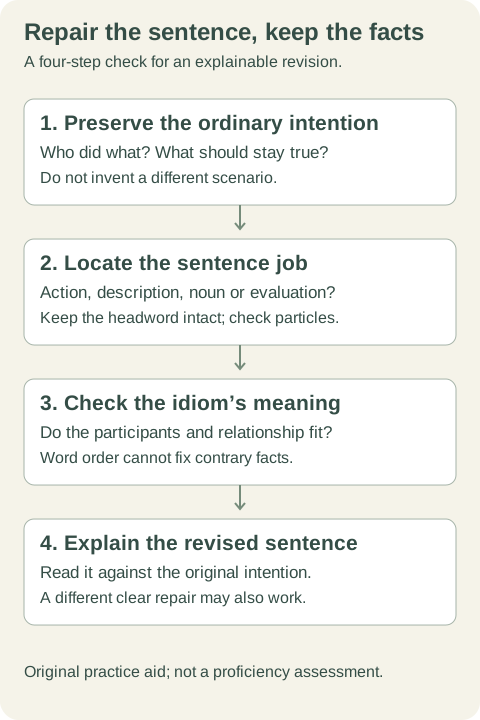
Twelve collocation and word-order exercises
Each question tells you what to preserve. The defective drafts are deliberately labeled practice drafts. The answer supplies a corrected Chinese sentence, a written pinyin aid and an English explanation. Read the reason for the change, especially when plain language is a better repair than keeping the idiom.
Do not judge a question only by whether you can guess what its writer meant. Ask whether the actual wording gives the intended action, referent and relationship. For open rewrites, a different clear sentence can be suitable if it preserves those features.
Case 1
A reader enjoyed a detective story. Repair this learner draft: 他津津有味了这个侦探故事。 Keep the story as what he read.
Show answer and explanation for case 1
Suggested repair: 他把这个侦探故事读得津津有味。 Pinyin: Tā bǎ zhège zhēntàn gùshi dú de jīn jīn yǒu wèi. English: He read the detective story with great interest.
津津有味 describes the interest or enjoyment here; it does not do the work of a transitive verb meaning “read.” Add 读 and place the description after 得. Another suitable repair is 他津津有味地读着这个侦探故事. The two patterns emphasize the same enjoyment through different sentence structures.
Case 2
She is listening to an introduction with interest. Correct the particle without changing the order: 她津津有味得听着介绍。
Show answer and explanation for case 2
Suggested repair: 她津津有味地听着介绍。 Pinyin: Tā jīn jīn yǒu wèi de tīngzhe jièshào. English: She is listening to the introduction with great interest.
The description comes before 听着 and tells how she listens, so this written pattern uses 地. In 她听得津津有味, the description follows the action and 得 introduces it. Both particles are normally read de here, so the pinyin alone does not identify the correct character.
Case 3
A reading group offers Chinese practice and a chance to meet new people. Repair the referent in this draft: 参加读书会能练习中文,也能认识新朋友,真是一举两得的朋友。
Show answer and explanation for case 3
Suggested repair: 参加读书会能练习中文,也能认识新朋友,真是一举两得的安排。 Pinyin: Cānjiā dúshūhuì néng liànxí Zhōngwén, yě néng rènshi xīn péngyou, zhēn shì yī jǔ liǎng dé de ānpái. English: Joining the reading group gives Chinese practice and a chance to meet new people—an arrangement with two benefits.
The two benefits come from participating in the group. Let 一举两得 describe that arrangement, rather than labeling the new friends. You could also finish with 真是一举两得 without the noun phrase. This is a referent-and-meaning correction, not a claim that idioms can never modify nouns.
Case 4
The same reading group lets you practice Chinese and meet people. Repair: 我们一举两得了新朋友。 Preserve both benefits in your sentence.
Show answer and explanation for case 4
Suggested repair: 参加这个读书小组,既能练习中文,又能认识新朋友,真是一举两得。 Pinyin: Cānjiā zhège dúshū xiǎozǔ, jì néng liànxí Zhōngwén, yòu néng rènshi xīn péngyou, zhēn shì yī jǔ liǎng dé. English: Joining this reading group both helps us practice Chinese and lets us meet new people: two benefits from one activity.
Do not use 一举两得 as a transitive verb meaning “meet” or “obtain friends.” Name the activity and its two gains, then evaluate it. The paired 既……又…… makes the benefits explicit. The idiom need not always appear with that exact pair; it is a helpful structure for this exercise.
Case 5
In this fictional situation, a template lets a team fill the same forms with less effort. Repair: 新模板事半功倍了我们的效率。
Show answer and explanation for case 5
Suggested repair: 用新模板填写同样的表格,可以事半功倍。 Pinyin: Yòng xīn múbǎn tiánxiě tóngyàng de biǎogé, kěyǐ shì bàn gōng bèi. English: Using the new template to fill the same forms can produce better results for less effort.
The idiom evaluates the effort-to-result relationship. It is not a causative verb meaning “increase our efficiency.” Keep 使用 or 用 as the action and use 可以事半功倍 as the evaluation. This fictional language example does not establish that a real template improves performance or that every efficient task literally doubles its output.
Case 6
The stated situation supports an efficiency benefit. Correct only the position of 的: 我们取得了的事半功倍效果。
Show answer and explanation for case 6
Suggested repair: 我们取得了事半功倍的效果。 Pinyin: Wǒmen qǔdé le shì bàn gōng bèi de xiàoguǒ. English: We achieved an efficient result: more effect for less effort.
事半功倍的 modifies 效果 as a unit. Put 的 between the description and its noun, not immediately after 取得了. MOE records the noun pattern 事半功倍的效果 in its examples. That evidence supports this repair; it does not restrict the idiom to this one noun or structure.
Case 7
After understanding a sentence pattern, a learner applies it to new situations. Repair: 理解这个句型后,他举一反三了三个新句子。
Show answer and explanation for case 7
Suggested repair: 理解这个句型后,他能举一反三,写出三个新句子。 Pinyin: Lǐjiě zhège jùxíng hòu, tā néng jǔ yī fǎn sān, xiě chū sān ge xīn jùzi. English: After understanding the pattern, he can extend what he learned and write three new sentences.
举一反三 expresses extending understanding from one case to other similar cases. 写出 supplies the actual sentence-writing action. Merely copying the original three times would not supply the same meaning. The number 三 in the fixed idiom is not a requirement to produce exactly three examples; this scenario happens to specify three.
Case 8
The learner uses one example to create other sentences. Correct the reordered idiom: 学完一个例句后,他反三举一,写出了其他同类的句子。
Show answer and explanation for case 8
Suggested repair: 学完一个例句后,他举一反三,写出了其他同类的句子。 Pinyin: Xué wán yī ge lìjù hòu, tā jǔ yī fǎn sān, xiě chū le qítā tónglèi de jùzi. English: After studying one example sentence, he applied the idea to other similar sentences.
The checked headword is 举一反三, not 反三举一. Preserve the conventional character order when you intend that idiom. A source may record other established variants, but rearranging these characters on your own is not a substitute for checking one. This exercise concerns the headword, not a ban on creative language in every context.
Case 9
A teacher gives a clue and the learner suddenly understands. Repair the cause-and-person structure: 老师的提示恍然大悟了我。
Show answer and explanation for case 9
Suggested repair: 听到老师的提示,我恍然大悟。 Pinyin: Tīngdào lǎoshī de tíshì, wǒ huǎng rán dà wù. English: On hearing the teacher’s clue, I suddenly understood.
The learner is the person who has the realization. The clue is what prompts it, not a subject that performs “realize me.” Move the cause into a phrase such as 听到老师的提示 and put 我 before the idiom. Another clear structure is 老师的提示让我恍然大悟; 让 supplies the causal link.
Case 10
The speaker suddenly recognizes the person as the new teacher. Repair the interrupted headword: 我恍然了大悟,原来他是新老师。
Show answer and explanation for case 10
Suggested repair: 我恍然大悟了,原来他是新老师。 Pinyin: Wǒ huǎng rán dà wù le, yuánlái tā shì xīn lǎoshī. English: I suddenly understood: he was the new teacher.
Use the complete idiom 恍然大悟 before the sentence-final 了 in this repair. Do not insert 了 inside the headword. The problem is the placement in this draft, not the mere presence of 了 after an idiom. You could also omit 了 and write 我恍然大悟:原来他是新老师.
Case 11
You and your roommate independently chose the same book without discussing it. Make this draft a clear, self-contained sentence: 我不约而同地选了这本书。
Show answer and explanation for case 11
Suggested repair: 我和室友不约而同地选了这本书。 Pinyin: Wǒ hé shìyǒu bù yuē ér tóng de xuǎn le zhè běn shū. English: My roommate and I independently chose the same book without arranging it beforehand.
The idiom compares matching opinions or actions without prior agreement. Naming both people makes that relationship visible in this standalone exercise. In a longer passage, relevant participants may already be supplied by context; the point is to preserve the comparison, not mechanically demand a plural pronoun in every possible sentence.
Case 12
They discussed the choice in advance and selected the same photograph as agreed. Repair the meaning while preserving that fact: 他们提前商量好后,不约而同地选了同一张照片。
Show answer and explanation for case 12
Suggested repair: 他们按照事先的约定,选了同一张照片。 Pinyin: Tāmen ànzhào shìxiān de yuēdìng, xuǎn le tóng yī zhāng zhàopiàn. English: They chose the same photograph according to their earlier agreement.
The original is structurally readable but its prior agreement conflicts with 不约而同. Changing 地 or moving the idiom would not fix that conflict. Use plain wording about the agreement. Removing the advance discussion from the scenario would change the facts, so it is not the requested repair.
Avoid four overcorrections after checking the answers
“All idioms replace a verb.” They do not. In the reading example, 读 carries the reading action and 津津有味 describes enjoyment. In the realization example, the person can 恍然大悟; the clue does not “realize” the person. Choose the structure from the phrase and the actual sentence.
“An idiom can never be followed by 了.” Question 10 shows why that is too broad. The repair keeps 恍然大悟 intact and places 了 after it. The defect was inserting the particle inside the headword. A correction rule should address the demonstrated problem rather than ban every superficially similar form.
“Changing the particle fixes the meaning.” Question 12 has matching choices made after advance agreement. It conflicts with 不约而同 even if the wording is tidied. Keep the prior agreement and describe it plainly. Word order and semantic compatibility require separate checks.
“The model is the only correct answer.” Some tasks allow a pre-action description or an after-action complement. Compare the action, participant and intended evaluation. A model sentence is a useful reference, not evidence that every other natural expression is wrong.
Download the questions and write a new version
Download the editable twelve-question sentence-repair sheet. It contains the original drafts, space for revisions, separate answer notes, pinyin, English and the dictionary links. You can keep the answer section hidden while trying the questions, or use it after writing to explain a correction.
Choose one structural question and one meaning question. For the structural question, change the activity or object while keeping the repaired pattern. For the meaning question, write two short scenarios: one where the idiom fits and one where it does not. Name the deciding fact in each. Check that your revised sentences have not copied the same defective structure into a new topic.
Use this record: ordinary intention; original draft; proposed repair; sentence job; relevant particle or headword order; meaning supported by the scenario; English explanation; remaining question. If the meaning remains uncertain, keep that uncertainty rather than forcing the phrase into the sentence. Return to the linked dictionary’s examples to compare the use, not merely its short gloss.
Choose the next practice task from the difficulty
Use the learning-workflow guide when you need a repeatable study routine, and the learning theme to explore related vocabulary. This worksheet handles a narrower task: revising twelve specific sentences and explaining their grammatical and semantic changes.
If the difficulty is deciding which meaning or tone fits, the clue-following and mechanical-reading comparison addresses a different choice. The correction and advance-preparation worksheet focuses on the relevant event and timing. The fortune-idiom comparison checks outcomes, overlap and conversational emphasis. None of those choices can be settled by inserting a particle mechanically.
For a new sentence, prefer a clear ordinary description when an idiom adds no useful meaning. Keep the expression when it carries a relationship or evaluation that the reader can see. Successful practice produces an explainable revision, not simply a longer sentence with four elegant characters.
Sources and further reading
- MOE Dictionary of Chinese Idioms: 不約而同Complete visible advanced entry checked for meaning, dictionary pinyin and actual use examples. Modern exercises and translations here are original.
- MOE Dictionary of Chinese Idioms: 津津有味Complete visible advanced entry checked for meaning, dictionary pinyin and actual use examples. Modern exercises and translations here are original.
- MOE Dictionary of Chinese Idioms: 一舉兩得Complete visible advanced entry checked for meaning, dictionary pinyin and actual use examples. Modern exercises and translations here are original.
- MOE Dictionary of Chinese Idioms: 事半功倍Complete visible advanced entry checked for meaning, dictionary pinyin and actual use examples. Modern exercises and translations here are original.
- MOE Dictionary of Chinese Idioms: 舉一反三Complete visible advanced entry checked for meaning, dictionary pinyin and actual use examples. Modern exercises and translations here are original.
- MOE Dictionary of Chinese Idioms: 恍然大悟Complete visible advanced entry checked for meaning, dictionary pinyin and actual use examples. Modern exercises and translations here are original.