Practice worksheet
Sai Weng Shi Ma vs Yin Huo De Fu: Meaning and Context
Both idioms can describe a benefit following a setback. 塞翁失马 adds the lost-horse allusion; 因祸得福 states the bad-to-good connection directly. Check what has actually happened, mark uncertain outcomes explicitly and choose wording that fits the listener.
Both can describe a blessing in disguise
塞翁失马 (sài wēng shī mǎ) and 因祸得福 (yīn huò dé fú) can both describe something good coming from an initially bad situation. Do not learn them as a strict pair of “the result is unknown” versus “the result is known.” The Ministry of Education’s idiom dictionary lists 因禍得福 as a near-synonym of 塞翁失馬, and its 塞翁失馬 examples include benefits that have already appeared.
The useful difference is what your sentence brings forward. 塞翁失马 invokes the lost-horse story and can encourage a wider view of changing fortune. 因祸得福 directly states that a benefit came from adversity. When the result is still open, wording such as 塞翁失马,焉知非福? asks whether the apparent loss might become a blessing. That question does not establish that it will.
This guide gives a choice process, eight original bilingual conversations and eight explained exercises. It separates the dictionary headwords from an expanded saying, and an actual positive turn from a hopeful prediction. Either idiom can be a poor choice when a listener needs practical help or a plain acknowledgement of loss.
| Feature | 塞翁失马 | 因祸得福 |
|---|---|---|
| Core meaning | A loss that turns beneficial; the story also invites perspective on changing fortune. | A benefit obtained because of an adverse situation. |
| What the phrase highlights | The lost-horse allusion and a reversal of apparent luck. | The bad-to-good connection stated directly. |
| Known benefit | Can fit a retrospective positive turn. | Can state that the positive turn happened. |
| Result still uncertain | An expanded question or modal can leave hope open. | A modal can predict a possible benefit; bare wording may sound more conclusive. |
| What neither establishes | No promise that every loss becomes beneficial. | No proof that the adverse event was desirable or that all harm is gone. |
Characters, pinyin and a useful English translation
The simplified headwords are 塞翁失马 and 因祸得福; traditional forms are 塞翁失馬 and 因禍得福. MDBG’s CC-CEDICT rows give sài wēng shī mǎ and yīn huò dé fú. Here 塞 is read sài, associated with the frontier setting; do not substitute sāi from another word.
塞翁 is the old man near the frontier, and 失马 is losing a horse. In 因祸得福, 因 links the adversity to the benefit: “gain a blessing because of misfortune.” These are literal memory aids, not requirements for a horse, a disaster or a religious blessing in every modern sentence.
“A blessing in disguise” can fit both when a setback has produced a benefit. For an open outcome, a fuller translation such as “Perhaps this setback will turn out for the best” better preserves the uncertainty. For 因祸得福, “Something good came out of the setback” often makes the connection clear without forcing the horse image into English.
The pinyin below gives dictionary-style written readings, not an audio demonstration or a rule that every syllable must be pronounced in isolation. English versions prioritize the conversational meaning. All dialogues are original teaching examples, not classical quotations or reports of real events.
The lost-horse source—and the limits of an origin claim
The MOE 塞翁失馬 entry identifies Huainanzi, “Ren Jian” (《淮南子·人间》), and reproduces the passage. A horse crosses into the frontier’s neighboring territory; people offer condolences. Later it returns bringing fine horses, and people congratulate the family. The son then falls while riding and injures his leg. When fighting arrives, that injury is connected with his and his father’s survival.
At the reversals, the father questions the apparent good or bad fortune. The reproduced passage concludes that blessing can become calamity and calamity can become blessing, with changes difficult to fathom. That supports a perspective on reversals. It does not prove that a person can reliably foresee a beneficial outcome after any particular loss.
The complete four-character expression 塞翁失馬 is not a verbatim phrase in the passage reproduced by MOE. The dictionary also documents later uses of the idiom. It is accurate here to connect the story to the cited Huainanzi passage; it would be inaccurate to invent a first-use date or call the entire modern expression a direct quotation from that excerpt.
The MOE 因禍得福 appendix defines it as encountering calamity and subsequently obtaining a benefit for some reason. It cites an occurrence in Xingshi Hengyan, volume nine, “Chen Duoshou: The Life-and-Death Couple” (《醒世恒言·卷九·陈多寿生死夫妻》), and mentions the variant 因禍為福. This is an attestation checked in the dictionary entry. It does not establish that the collection invented the expression, and this guide has not read the complete story or compared earlier editions.
MOE’s 塞翁失馬 usage examples are especially useful for the choice problem: some express hope about a current loss, while others describe a benefit already obtained. Treat those examples as evidence against a mandatory “unknown result” rule. The broader story and the headword’s recorded uses must both be respected.
Check the outcome before choosing the emphasis
Start with two facts: what initially looked bad, and what benefit, if any, followed from it. If the second fact is unknown, write “unknown.” Do not fill that gap with the idiom itself. If a benefit has appeared, ask whether the sentence wants a story-shaped perspective or a direct statement about the result.
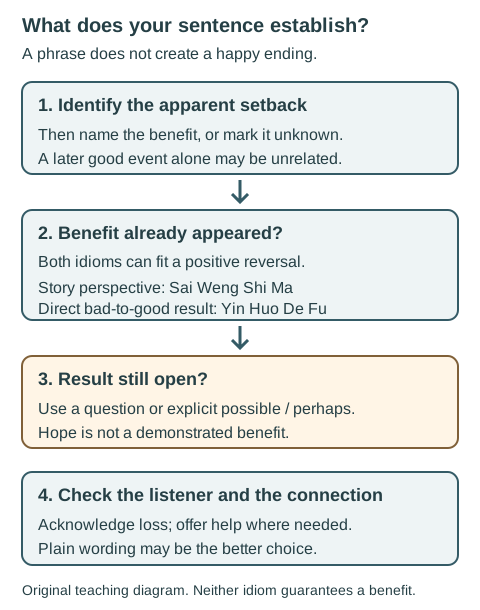
| Situation | Useful wording | Reason |
|---|---|---|
| The setback led to a known benefit | 这次真是因祸得福。 / 这也算塞翁失马了。 | Both can fit; provide the setback and benefit in context. |
| The benefit is only a possibility | 说不定以后会因祸得福。 / 塞翁失马,焉知非福? | The modal or question carries the uncertainty. |
| A good event followed but is unrelated | Name the two events plainly. | Sequence alone does not establish the bad-to-good connection. |
| Someone has just suffered serious loss | Acknowledge the loss and ask what help is needed. | An idiom can minimize the listener’s experience or suggest an unsupported happy ending. |
A setback can produce one useful consequence while leaving other harms unresolved. Say what improved rather than claiming that the entire experience became good. The expression is an interpretation of a relationship between events, not a balanced assessment of every consequence.
Eight original conversations, with pinyin and context
Read the situation and both speakers before choosing a phrase. The notes explain appropriate overlap, deliberately avoided wording and cases where neither is established.
1. A rejection followed by a suitable opportunity
A:上次没被录取,后来却找到了更合适的课程。
B:这也算塞翁失马了。
A: Shàng cì méi bèi lùqǔ, hòulái què zhǎodào le gèng héshì de kèchéng.
B: Zhè yě suàn sài wēng shī mǎ le.
English: A: I was not admitted last time, but later found a course that suited me better. B: That turned out to be a blessing in disguise.
The benefit is known. 塞翁失马 is not excluded; 因祸得福 could also describe this positive turn. The example evaluates this particular outcome, not every rejection.
2. State the same connection directly
A:如果没有那次取消,我就不会参加这个小组。
B:看来你这次因祸得福了。
A: Rúguǒ méiyǒu nà cì qǔxiāo, wǒ jiù bú huì cānjiā zhège xiǎozǔ.
B: Kànlái nǐ zhè cì yīn huò dé fú le.
English: A: Without that cancellation, I would not have joined this group. B: It looks as if something good came out of it this time.
因祸得福 makes the cancellation-to-benefit connection explicit. 看来 marks the speaker’s assessment; 这次 keeps it local. It does not imply all cancellations are fortunate.
3. Leave an unresolved setback open
A:计划取消了,我还不知道下一步怎么办。
B:塞翁失马,焉知非福?我们先看看还有什么选择。
A: Jìhuà qǔxiāo le, wǒ hái bù zhīdào xià yí bù zěnme bàn.
B: Sài wēng shī mǎ, yān zhī fēi fú? Wǒmen xiān kànkan hái yǒu shénme xuǎnzé.
English: A: The plan has been cancelled, and I do not know what to do next. B: Perhaps it may turn out for the best. Let us see what other choices are available.
The expanded question leaves possibility open. The second sentence offers a concrete next step rather than using optimism as a guarantee. Whether the phrase feels welcome still depends on the listener.
4. A modal can qualify 因祸得福 too
A:这次换地方,会不会有新的机会?
B:说不定以后会因祸得福,不过现在还不能确定。
A: Zhè cì huàn dìfang, huì bú huì yǒu xīn de jīhuì?
B: Shuōbudìng yǐhòu huì yīn huò dé fú, búguò xiànzài hái bù néng quèdìng.
English: A: Might changing places this time bring new opportunities? B: Perhaps something good will come of the setback later, but we cannot know yet.
说不定 and 会 make this a possibility, not a report of an achieved benefit. The headword does not override the sentence’s modal wording. Without that qualification, a conclusion may sound premature.
5. Do not turn reassurance into a demand
A:我现在只觉得难过。
B:我明白。先不急着说塞翁失马,你需要我帮什么忙?
A: Wǒ xiànzài zhǐ juéde nánguò.
B: Wǒ míngbai. Xiān bù jí zhe shuō sài wēng shī mǎ, nǐ xūyào wǒ bāng shénme máng?
English: A: Right now I just feel upset. B: I understand. We need not rush to call it a blessing in disguise. What can I help with?
The phrase appears as something the speaker deliberately postpones. This models acknowledging emotion without telling another person how they must interpret a loss.
6. A benefit does not erase the damage
A:虽然发现了新办法,损失还是很大。
B:是的,不能只用因祸得福就把损失带过去。
A: Suīrán fāxiàn le xīn bànfǎ, sǔnshī háishi hěn dà.
B: Shì de, bù néng zhǐ yòng yīn huò dé fú jiù bǎ sǔnshī dài guòqù.
English: A: We found a new method, but the loss is still substantial. B: Yes. Calling it a blessing in disguise should not brush the loss aside.
A positive consequence and continuing harm can coexist. The idiom is not an accounting method that cancels all costs. Here plain acknowledgement is the focus.
7. A later good event is not enough
A:昨天丢了钥匙,今天收到朋友的礼物,这算因祸得福吗?
B:如果两件事没有关系,直接说今天收到礼物就好。
A: Zuótiān diū le yàoshi, jīntiān shōudào péngyou de lǐwù, zhè suàn yīn huò dé fú ma?
B: Rúguǒ liǎng jiàn shì méiyǒu guānxi, zhíjiē shuō jīntiān shōudào lǐwù jiù hǎo.
English: A: I lost my keys yesterday and received a gift today. Is that good coming from bad? B: If the events are unrelated, just say you received a gift today.
This is a question-and-correction example, not an endorsed use. A pleasant event after a loss does not itself show that the loss produced the benefit.
8. Choose between two acceptable emphases
A:这段经历可以说塞翁失马,也可以说因祸得福吗?
B:可以,如果你把先前的挫折和后来的好处说清楚。
A: Zhè duàn jīnglì kěyǐ shuō sài wēng shī mǎ, yě kěyǐ shuō yīn huò dé fú ma?
B: Kěyǐ, rúguǒ nǐ bǎ xiānqián de cuòzhé hé hòulái de hǎochu shuō qīngchu.
English: A: Can this experience be described with either expression? B: Yes, if you make the earlier setback and later benefit clear.
The facts determine whether either fits. Choose 塞翁失马 for the story allusion, or 因祸得福 for the direct bad-to-good statement; do not invent an exclusive result-status boundary.
Tone, practical help and different kinds of response
Both expressions can reassure, but a reassuring intention does not ensure a reassuring effect. Someone describing their own small setback may welcome a story allusion. A person facing grief, injury or a substantial loss may hear it as a dismissal. Ask what the listener needs rather than assuming that an idiom supplies support.
Use context-setting words carefully. 这次 means “this time,” 看来 marks an assessment, and 也算 offers a qualified characterization. 也许 and 说不定 mark possibility. These are useful patterns for original sentences, not a corpus-ranked list of the most frequent collocations.
“A blessing in disguise” also needs context in English. For an unresolved situation, “may turn out for the best” is different from “turned out for the best.” Keep that distinction in the translation. Do not translate every 塞翁失马 sentence as “we cannot know yet” when the speaker has already named a benefit.
Other idioms answer different questions. 亡羊补牢 and 未雨绸缪 distinguish useful correction after a mistake from preparation before a relevant difficulty. They describe an action’s purpose and timing. 塞翁失马 and 因祸得福 describe how events are interpreted as misfortune and benefit. A person can repair a problem without having obtained an unexpected blessing.
Eight context checks with explained answers
Try the questions before opening the answers. These original cases test meaning, source scope and conversational judgement. Some accept both expressions or plain wording rather than forcing one headword.
Case 1
A rejected application led someone to a course that later suited them better. Must 塞翁失马 be wrong because the benefit is already known?
Show answer and explanation for case 1
No. Both expressions can fit the known positive turn.
MOE records retrospective beneficial uses of 塞翁失马 and lists 因禍得福 as a near-synonym. Choose the story allusion or direct outcome emphasis, and explain the earlier setback and later benefit.
Case 2
A plan was cancelled, and no benefit has appeared. Does “塞翁失马,焉知非福?” establish a happy ending?
Show answer and explanation for case 2
No. The expanded question leaves a possible benefit open.
It can offer a perspective on uncertainty, but it does not demonstrate or promise the result. Preserve the question or possibility in translation and consider whether the listener welcomes this reassurance.
Case 3
A sentence says “说不定以后会因祸得福.” Must it report an already achieved benefit?
Show answer and explanation for case 3
No. It predicts a possibility.
说不定 and 会 qualify the claim. Do not apply a rigid known-result rule to the headword while ignoring the grammar of the actual sentence. A bare retrospective statement would communicate a different outcome status.
Case 4
A person lost their keys and received an unrelated gift the next day. Is that alone enough for 因祸得福?
Show answer and explanation for case 4
No. A bad-to-good connection is not established.
Chronological order alone is insufficient. Describe the gift plainly unless the facts show that the loss brought about the benefit; do not invent that causal or explanatory connection.
Case 5
A useful new method emerged after a costly failure. Does either idiom mean every loss has been cancelled out?
Show answer and explanation for case 5
No. Name the benefit and acknowledge the continuing harm.
A beneficial consequence can coexist with substantial damage. Neither expression proves that the failure was desirable or that a whole experience has become positive in every respect.
Case 6
Does the full four-character expression 塞翁失馬 occur verbatim in the Huainanzi passage reproduced by MOE?
Show answer and explanation for case 6
No. The reproduced passage supplies the story, not that complete phrase.
MOE connects the idiom to the passage and also records later attestations. Do not turn the story-source connection into a fabricated direct quotation, first-use date or claim to have compared all classical editions.
Case 7
The 因禍得福 appendix cites Xingshi Hengyan. Does that establish the expression’s inventor or earliest use?
Show answer and explanation for case 7
No. It establishes the cited attestation in this dictionary entry.
The short appendix does not supply a complete origin history. This guide has checked the entry’s wording, not the full cited story or an exhaustive earlier-text search. Keep the scope of the source claim explicit.
Case 8
A friend has just experienced a serious loss and wants practical help. Must you use a fortune idiom to be encouraging?
Show answer and explanation for case 8
No. Acknowledge the loss and ask what help is needed.
A hopeful phrase can feel premature or minimizing. Plain support can better match the conversation. Neither the dictionary meaning nor the lost-horse story obliges the listener to reinterpret their situation as fortunate.
Download the context sheet and rewrite one situation
Download the editable fortune-idiom context sheet. It includes the blank choice record, eight bilingual conversations, eight questions with separate answer notes and verified source links.
FORTUNE-IDIOM PHRASE-CHOICE RECORD
Apparent setback:
Actual benefit, or unknown:
How the setback connects to the benefit:
What the sentence emphasizes: story / direct result / possibility:
Chosen phrase and any modal or question:
Listener's situation and practical help needed:
Continuing harm that the sentence must not erase:
Plain English translation preserving outcome status:
First write a version in which the benefit has already appeared. Try both idioms and explain the change in emphasis. Then rewrite the same situation before any benefit is known, using an explicit possibility or question. Translate the sentences separately; an English past tense should not replace a Chinese prediction.
Finally try a plain supportive reply without either idiom. This tests whether the expression adds the meaning and tone you intend. For the single-idiom story and forms, return to the 塞翁失马 entry; use this worksheet when the task is choosing between two overlapping expressions.
Sources and further reading
- MOE Dictionary of Chinese Idioms: 塞翁失馬Definition, pinyin, reproduced Huainanzi passage, later attestations, near-synonym and both open-outcome and retrospective usage examples.
- MOE Dictionary of Chinese Idioms: 因禍得福 appendixFully read short visible entry: pinyin, bad-to-good definition, 因禍為福 variant and Xingshi Hengyan attestation; not an earliest-use study.
- MDBG / CC-CEDICT: 塞翁失馬Independent bilingual headword and sài wēng shī mǎ pronunciation check; blessing-in-disguise gloss.
- MDBG / CC-CEDICT: 因禍得福Independent yīn huò dé fú pronunciation and good-coming-from-bad gloss; optional AI descriptions are not used.